
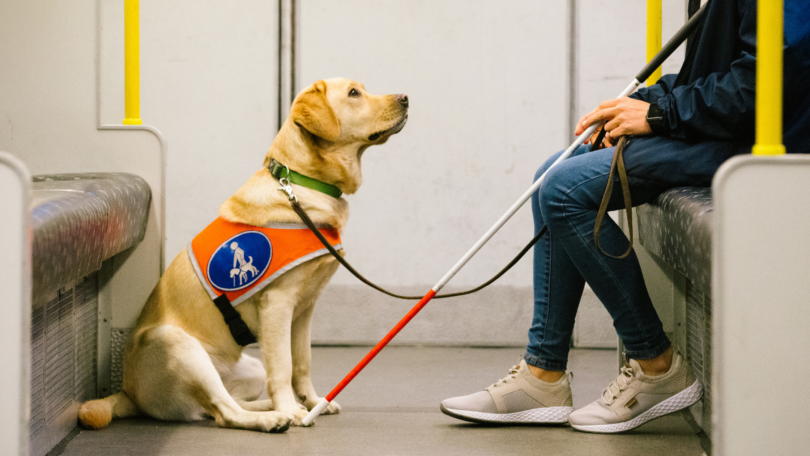

Picture yourself at a busy intersection, unable to see the traffic. You listen to the rhythm of the engines, wait for the surge of cars moving parallel to you, and decide it’s time to cross. Then, just as you step toward the curb, the dog at your side stops and refuses to move, as a car you never heard swings through the turn in front of you.
That moment captures what a guide dog really is. It isn’t a pet, and it isn’t a GPS on four legs. It’s a highly trained working partner that helps people who are blind or have low vision travel safely and independently. The partnership took centuries to imagine and roughly a hundred years to perfect. This timeline walks through how guide dogs went from an informal, one-off arrangement to one of the most carefully bred and trained working animals in the world.
A quick myth to clear up first: guide dogs don’t read traffic lights. The handler decides when to cross, usually by listening to the flow of traffic. The dog’s job is to guide in a straight, safe line and to refuse a command if danger appears. More on that skill, called “intelligent disobedience,” below.
Before the Modern Guide Dog: Ancient and Early Clues
Dogs have probably helped blind people find their way for as long as the two have shared a road. One of the earliest known images is a first-century AD mural from the ruins of Roman Herculaneum (some accounts place it in nearby Pompeii; both towns were buried by Mount Vesuvius in AD 79) that appears to show a blind man being led by a dog. A 13th-century Chinese scroll, Spring on the Yellow River, in the collection of The Metropolitan Museum of Art in New York, includes a similar scene, and references to dogs leading blind people turn up in medieval European writing and, later, in paintings and engravings by artists such as Thomas Gainsborough and Thomas Bewick.
These images tell us that people understood a dog’s potential as a guide long ago. What they lacked was a method: a reliable way to train the dog and teach the person to work with it. That began to take shape in the late 1700s and 1800s:
- Around 1780: Les Quinze-Vingts, a hospital for the blind in Paris, is often credited with the first systematic attempt to train guide dogs. The evidence is indirect: Viennese eye specialist Georg Joseph Beer later wrote that blind residents there used well-trained dogs, based partly on a painting by Jean-Siméon Chardin exhibited in 1752.
- 1788: Josef Riesinger, a blind sieve maker in Vienna, reportedly trained a Spitz so well that people doubted he was blind.
- 1819: Johann Wilhelm Klein, founder of Vienna’s Institute for the Education of the Blind, published the earliest surviving description of a systematic method for training guide dogs. He recommended a rigid stick attached to the dog’s collar in place of a leash, an early ancestor of today’s harness handle, though there’s no record his method was widely put into practice.
- 1847: Jakob Birrer, a blind man from Switzerland, published an account of being guided for five years by a dog he had trained himself.
These were individual efforts. Training guide dogs on a large scale would take a world war.
1916: World War I and the First Guide Dog School
World War I sent thousands of soldiers home blinded, many by poison gas. In Germany, physician Dr. Gerhard Stalling noticed something remarkable while walking with a blinded patient on hospital grounds. Called away urgently, he left his own dog with the man for company, and when he returned, the dog seemed to be looking after him.
Stalling began exploring how to train dogs as reliable guides. In August 1916, working with the German Association for Ambulance Dogs, he opened the world’s first guide dog school in Oldenburg. The first dog was placed that year with a blinded veteran named Paul Feyen. Within a year, 100 more had been issued, and by 1919 the number had reached 539.
The program grew quickly. Branches opened in Bonn, Breslau, Dresden, Essen, Freiburg, Hamburg, Magdeburg, Münster, and Hanover, training up to 600 dogs a year. Civilian classes began in 1922, and dogs were sent to blind people in Britain, France, Spain, Italy, the United States, Canada, and the Soviet Union.
But rapid growth took a toll on quality, and the Oldenburg venture closed in 1926. That wasn’t the end of the story. In 1923 the German Shepherd Dog Association had opened a large training center in Potsdam, near Berlin, which could house about 100 dogs at a time and turn out up to 12 fully trained guides a month. Potsdam formalized practices most schools still follow: selecting good dogs, matching them carefully to handlers, and following up in the home. It was about to capture the attention of an American dog breeder living in Switzerland.
1927–1928: Dorothy Harrison Eustis and Morris Frank
Dorothy Harrison Eustis, born in Philadelphia, was living near Vevey, Switzerland, where she ran a kennel called Fortunate Fields. There, with trainer Elliott “Jack” Humphrey, she bred and trained German shepherds for police and military work.
After spending time at the Potsdam school, Eustis wrote an article titled “The Seeing Eye,” published in The Saturday Evening Post on November 5, 1927. It described German guide dogs working with blinded veterans, and it drew a flood of letters.
One came from Morris Frank, a 19-year-old from Nashville, Tennessee, who had lost his sight in two separate accidents. Frank asked for a guide dog of his own and promised that, if Eustis would train him, he would help bring guide dogs to the United States. Eustis had never trained dogs for blind people, but she agreed. In 1928, Frank traveled to Fortunate Fields and trained with a German shepherd he named Buddy.
On June 11, 1928, Frank arrived back in New York City. In front of a crowd of skeptical reporters, Buddy guided him safely across a dangerous, busy street. Frank then sent Eustis a one-word telegram: “Success.”
1929: The Seeing Eye Opens
On January 29, 1929, Eustis and Frank incorporated The Seeing Eye in Nashville, the first guide dog school in the United States. Eustis served as president and Frank as managing director. The first class was held that February, and the school graduated its first two students a month after it was founded.
In 1931 the school moved to Whippany, New Jersey, and it now operates from a campus in Morris Township. Today The Seeing Eye is the oldest guide dog school still operating anywhere in the world. (“Seeing Eye dog” is actually a registered trademark for dogs from this school; the general term is “guide dog.”)
Frank spent years traveling the country with Buddy, demonstrating what a guide dog could do and pushing for the right to be accompanied by his dog in hotels, restaurants, trains, and other public places. That advocacy laid early groundwork for the access rights guide dog handlers have today.
1930s–1940s: Guide Dogs Spread Around the World
In Britain, two German shepherd enthusiasts, Muriel Crooke and Rosamund Bond, heard about The Seeing Eye and contacted Eustis, who sent over one of her trainers. Working from a lock-up garage in Wallasey (then part of Cheshire, now Merseyside), they trained Britain’s first four guide dogs: Flash, Judy, Meta, and Folly. The dogs were handed over to blinded World War I veterans on October 6, 1931. Captain Nikolai Liakhoff, a former Russian army officer, later became the program’s first permanent trainer, and in 1934 the Guide Dogs for the Blind Association was founded. The early work was not always welcome: trainers recalled members of the public trying to stop them, calling it cruel to make a dog work.
In the United States, new schools followed The Seeing Eye:
- 1939: Members of the Uptown Lions Club of Detroit founded what became Leader Dogs for the Blind in Rochester, Michigan, inspired by a fellow Lion who had lost his sight. The first class graduated that October.
- 1942: As World War II sent blinded veterans home, trainers Lois Merrihew and Don Donaldson founded Guide Dogs for the Blind in Los Gatos, California. The school later moved to San Rafael.
- 1946: Community leaders in New York founded the Guide Dog Foundation for the Blind, providing dogs at no charge to veterans and civilians.
This era also began a gradual shift in breeds. Early guide dogs were mostly German shepherds, but British quarantine rules made it hard to import trained dogs, prompting a search for other suitable breeds, predominantly Labradors. Over the following decades, many schools moved away from German shepherds toward Labrador retrievers, golden retrievers, and Lab-golden crosses, prized for their temperament and trainability.
1950s–1970s: From Craft to Profession
After the war, guide dog training became a true profession. Schools built their own breeding programs instead of relying on donated dogs, selected puppies more systematically, and developed formal apprenticeships for instructors. Volunteer puppy raisers became central to the process: families who raise a puppy for its first year or so, teaching house manners and exposing it to the sights and sounds of everyday life before it returns for formal training. Leader Dogs, for example, placed its first puppies with a local 4-H club in 1958, the same year it made its services free to clients.
The focus shifted toward the partnership itself: how dog and handler communicate, and how instructors can teach both to work as a team. Legal protections grew alongside. “White cane laws,” which began as local ordinances in the 1930s, spread until every U.S. state had one, requiring drivers to yield to blind pedestrians traveling with a white cane or guide dog. In 1964, Congress designated October 15 as White Cane Safety Day.
1980s–1990s: Global Standards and Civil Rights
Conferences of guide dog schools in France (1973) and London (1976) sparked the idea of an international body. In 1989 it became official with the founding of what is now the International Guide Dog Federation (IGDF). The federation sets and accredits standards for training, dog welfare, and client services, shifting the central question from “Can a dog guide a person?” to “How do we make sure every partnership is safe, ethical, and high quality?” Its founding date, April 26, 1989, is marked each year by International Guide Dog Day on the last Wednesday in April.
The legal landscape changed too. The Air Carrier Access Act of 1986 barred airlines from discriminating against travelers with disabilities and today requires them to accept service dogs. The Americans with Disabilities Act (ADA) of 1990 guaranteed people with service animals access to businesses, restaurants, public transportation, and other public places. Updated federal rules effective in 2011 clarified that under the ADA only dogs are recognized as service animals (with a separate provision for miniature horses), that no certification or vest is required, and that staff may ask only two questions: whether the dog is required because of a disability, and what task it has been trained to perform.
2000s–Today: The Modern Guide Dog
Today’s guide dog programs are shaped by science as much as by experience. Schools study genetics, health, and behavior, and some share puppies from successful parents with schools in other countries to keep breeding gene pools diverse. Matching has become highly individualized, weighing the handler’s needs, walking pace, and everyday environment, whether that means a quiet suburb or a daily subway commute. Even the dog’s height matters, since it has to fit the handler’s height with the harness.
Not every puppy becomes a guide dog. Those better suited to other work are “career changed” into roles such as service, detection, or veteran support. In the UK, guide dogs retire on or before their 11th birthday, and many stay with their handler as pets while others are adopted by members of the public.
Services have broadened as well: Leader Dogs began a program for DeafBlind clients in 1992, the Guide Dog Foundation launched America’s VetDogs for veterans in 2003, and Guide Dogs UK has expanded services for children and young people with sight loss. The IGDF now counts about 100 member organizations around the world.
What a Guide Dog Actually Does
It helps to be clear about the division of labor. The handler navigates: they know the route, give directions, and decide when it’s safe to cross. The dog guides: it walks in a straight line, stops at curbs and stairs, and steers around obstacles, including overhead ones like low branches.
The most impressive skill is intelligent disobedience, knowing when not to obey. If the handler says “forward” but a car is approaching, a well-trained guide dog will refuse to move until the path is safe, and once in the intersection it will guide the handler safely to the other side.
Guide dog etiquette: If you see a guide dog in harness, it’s working. Don’t pet it, call to it, feed it, or otherwise distract it; a distracted dog can lead its handler into danger. If you think the handler needs help, speak to the person, not the dog.
Looking Ahead
The next chapter of guide dog history is likely to focus on healthier, longer-working dogs through ethical breeding and genetics research; even better matching between dogs and handlers; and technology such as GPS apps and smart canes that complements, rather than replaces, a canine partner.
Access remains unfinished work. Guide dog users still report being turned away by rideshare drivers, taxis, restaurants, and shops, despite clear legal protections; the IGDF and Assistance Dogs International have surveyed handlers about these experiences as part of a campaign for better access. Public awareness is part of the solution, which is one more reason stories like this one matter.
Conclusion
From a painted wall in Herculaneum to a telegram that read “Success,” the history of the guide dog is a history of independence. What began as an experiment to help blinded veterans has become a global, standards-driven practice built on trust, careful training, and animal welfare. The goal is the same as it was in 1916: to help people move through the world, and through life, with freedom and confidence.