
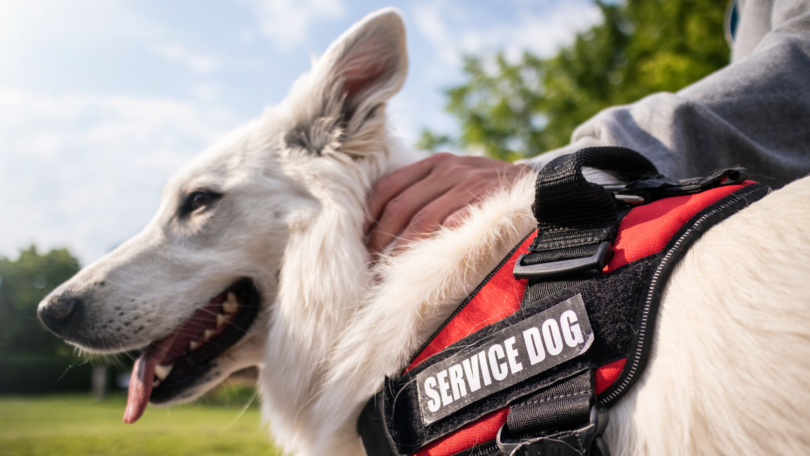

For most of us, a dog is a best friend. For millions of people with disabilities, a dog is also the key to a more independent life.
But not every helping dog plays the same role, and the law doesn’t treat them all the same way. Guide dogs, service dogs, and emotional support animals (ESAs) are often lumped together, yet they differ in training, history, and where they’re legally allowed to go.
In this post, we’ll walk through what each one does, how each came to be, and how federal law treats them in public places, housing, and air travel.
Guide Dogs
Guide dogs help people who are blind or have low vision travel safely and independently. They lead their handler around obstacles, stop at curbs and stairs, and are trained to refuse a command that would put their handler in danger.
Under the Americans with Disabilities Act (ADA), a guide dog is a service dog, so it has the same broad public access rights. Guide dog handlers are also protected in housing under the Fair Housing Act and on flights under the Air Carrier Access Act (more on each below).
A Brief History of Guide Dogs
Guide dogs have the longest and best-documented history of the three. Images of dogs leading blind people go back as far as a first-century Roman mural from Herculaneum, but the first guide dog school opened in Oldenburg, Germany, in 1916 to serve soldiers blinded in World War I.
A decade later, Dorothy Harrison Eustis, an American training German shepherds in Switzerland, wrote about Germany’s guide dogs for The Saturday Evening Post. A young blind man from Nashville named Morris Frank read it and asked for her help. After training with his dog, Buddy, Frank proved to skeptical reporters that a guide dog could lead him safely through New York traffic. In 1929, he and Eustis founded The Seeing Eye, the first guide dog school in the United States. Their work helped change how the public saw guide dogs: not as helpful pets, but as partners in independence.
For the full story, check out our complete timeline of the guide dog.
Service Dogs
Here’s the simplest way to remember it: all guide dogs are service dogs, but not all service dogs are guide dogs.
The ADA defines a service dog as a dog that is individually trained to do work or perform tasks for a person with a disability, and the task must be directly related to that disability. That covers physical, sensory, psychiatric, intellectual, and other disabilities. Service dogs may:
- Retrieve dropped items, open doors, or help with balance for people with mobility disabilities
- Alert a person who is deaf to sounds like a doorbell or smoke alarm
- Alert to low blood sugar or an oncoming seizure
- Interrupt a panic attack, apply deep pressure, or remind a person to take medication
That last group describes psychiatric service dogs, which are often confused with ESAs because both relate to mental health. The difference is training. A dog that has been trained to sense an anxiety attack and take a specific action to help is a service dog. A dog whose mere presence provides comfort is not.
A Brief History of Service Dogs
For most of the 20th century, “assistance dog” meant “guide dog.” That changed in 1975, when Bonita “Bonnie” Bergin, a teacher in Northern California, had an idea: if dogs could guide people who are blind, why couldn’t they help people with other disabilities too?
Bergin found her first partner in Kerry Knaus, a woman with quadriplegia, and trained a puppy named Abdul to help her with everyday tasks. That same year, Bergin founded Canine Companions for Independence in Santa Rosa, California, the first program of its kind. She is widely credited with coining the term “service dog”.
Bergin went on to found the Assistance Dog Institute in 1991, now known as the Bergin College of Canine Studies. Today, service dogs assist people with a huge range of disabilities, from mobility impairments and diabetes to PTSD.
Emotional Support Animals
An emotional support animal provides comfort to a person with a mental health condition simply by being there. ESAs aren’t trained to perform specific tasks, and that’s the key legal difference: because they aren’t task-trained, ESAs are not service animals under the ADA.
ESAs also don’t have to be dogs. Cats are common, and people have kept rabbits, birds, and other animals as ESAs.
It’s also worth knowing about a fourth category that often gets mixed in: therapy dogs. These are dogs that visit hospitals, schools, nursing homes, and disaster areas to comfort many people, not just their owner. Therapy dogs don’t have special public access rights under the ADA either.
A Brief History of Emotional Support Animals
People have long known that animals are good for our mental health, but ESAs as a legal category are much newer than guide or service dogs.
Their legal foundation dates to the Fair Housing Amendments Act of 1988, which added people with disabilities as a protected class under the Fair Housing Act. That opened the door for people with mental health conditions to request an animal as a “reasonable accommodation” in housing with a no-pets policy. The term itself is surprisingly recent: Merriam-Webster dates the first known use of “emotional support animal” to 2000.
ESAs became much more common in the 2000s and 2010s, especially on airplanes, which eventually led to the rule changes described below.
Legal Differences
Now for the question most people are really asking: where can each type of animal legally go? Here’s how federal law breaks down. State and local laws vary and sometimes offer broader protections, so always check the rules where you live.
This section is for general information only and isn’t legal advice.
Public Places
Under the ADA, guide dogs and other service dogs are allowed anywhere the public is allowed, including restaurants, stores, and hospitals, even if the business has a “no pets” policy.
Contrary to a common belief, handlers don’t need to show any documentation. When it isn’t obvious what a dog does, staff may ask only two questions:
- Is the dog a service animal required because of a disability?
- What work or task has the dog been trained to perform?
Staff can’t ask for paperwork, ask the dog to demonstrate its task, or ask about the person’s disability. A business can ask for a service dog to be removed if it’s out of control or not housebroken. Dogs still in training aren’t covered by the ADA, though some state laws protect them.
ESAs don’t have public access rights under the ADA. Whether an ESA is welcome is up to the business, unless a state or local law says otherwise.
Housing
The Fair Housing Act requires housing providers to make reasonable accommodations for people with disabilities, and that can include allowing a service dog or an ESA in a building with a no-pets policy.
For years, HUD guidance filled in the details, such as not charging pet fees or deposits for assistance animals, and what documentation a landlord could reasonably request when a disability isn’t obvious. However, in September 2025, HUD withdrew its two main guidance documents on assistance animals. The Fair Housing Act’s reasonable accommodation requirement still stands, but the specifics are now less clear at the federal level, making state and local housing laws more important than ever. Tenants remain responsible for any actual damage their animal causes.
Air Travel
Under the Air Carrier Access Act, airlines must accept trained service dogs in the cabin at no charge, and psychiatric service dogs must be treated like any other service dog. Airlines can require DOT forms, limit passengers to two service dogs, and require the dog to fit in the handler’s foot space.
ESAs lost their special status with a 2020 Department of Transportation rule. Airlines no longer have to recognize ESAs as service animals and may treat them as pets, which usually means following pet rules and paying a pet fee.
At a Glance
|
|
Guide Dog |
Service Dog |
Emotional Support Animal |
|---|---|---|---|
|
Primary role |
Guides a person who is blind or has low vision |
Performs tasks related to a person’s disability |
Provides comfort through companionship |
|
Task training required? |
Yes |
Yes |
No |
|
Type of animal |
Dog |
Dog (the ADA has a separate provision for miniature horses) |
Can be many species |
|
Public access (ADA) |
Yes |
Yes |
No |
|
Housing (Fair Housing Act) |
Yes |
Yes |
Often, as a reasonable accommodation |
|
In-cabin air travel (ACAA) |
Yes, free |
Yes, free |
Only under the airline’s pet policy |
Common Misconceptions About Assistance Animals
Let’s bust three of the most common myths.
Myth 1: “All assistance animals are service animals.”
The truth: Only dogs individually trained to perform disability-related tasks qualify as service dogs under the ADA. ESAs provide real comfort, but because they aren’t task-trained, they aren’t service animals.
Myth 2: “A service dog must wear a vest and be certified.”
The truth: The ADA doesn’t require vests, ID tags, or certification, and there is no official government service dog registry. Websites selling “official” service dog certificates or registrations are selling something the law doesn’t recognize. What makes a service dog is its training, not its gear.
Myth 3: “A service dog is just a well-trained pet.”
The truth: Service dogs are working animals, not pets. Many train for a year or more to perform specific tasks reliably in busy, distracting environments, and their work lets their handlers live more independently.
Why the Differences Matter
Understanding these categories helps everyone. Businesses and landlords know what they can and can’t ask, handlers can more easily exercise their rights, and the rest of us know how to behave around a working dog.
That last part matters more than you might think. A distracted service dog can miss a cue its handler depends on. If you see a dog in a vest or harness, don’t pet it, call to it, or feed it without asking the handler first. Some ESA owners may be happy to let you say hello, but it’s always best to ask.
Conclusion
Guide dogs help people who are blind or have low vision navigate the world. Service dogs perform trained tasks for people with a wide range of disabilities. And emotional support animals offer comfort to people living with mental health conditions.
Their legal rights aren’t interchangeable, but they all share something special: they show just how much a dog can change a person’s life. That bond is as old as that mural in Herculaneum, and it keeps growing stronger.